UK Patent Feasibility Screening
Find five directions you could file in the UK from a technical description or business plan, and see which parts UK law excludes from patent protection.
What it does, and what it doesn't
UK patent law excludes computer programs and business methods "as such", and many software and AI products fall at that hurdle. This tool finds five directions in your material you could file in the UK, and gives each a verdict:
- Ready to draft: the technical contribution stands on its own. A patent attorney can draft from it as it is.
- Needs re-describing: there is a real technical core, but it is described in commercial terms. Restate it as engineering before drafting. It is an instruction, not a rejection.
Business methods, game rules and the presentation of information can't be rescued by rewording. The full report lists them under "What cannot be patented".
It doesn't search for existing patents, so it can't tell you whether someone has filed something similar. It isn't legal advice, it doesn't predict whether anything will be granted, and it files nothing with the UK Intellectual Property Office.
Who it's for
- Start-ups building software or AI products that want UK patent protection.
- Founders with a business plan who can't yet say which parts of their technology are worth protecting.
What to prepare
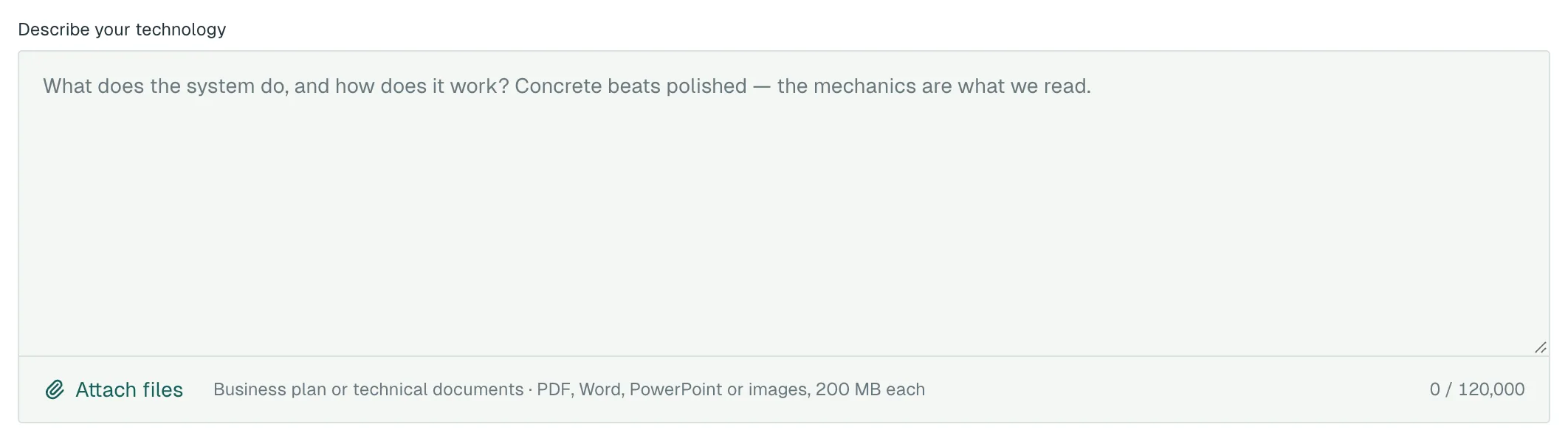
- A technical description: what the system does and how, what the parts are and what happens between them.
- Or your business plan or technical documents: PDF, Word, PowerPoint or images, up to 200 MB each. Files over 50 MB need you to be signed in.
- Material over 120,000 characters is trimmed, with technical sections kept first.
- Nothing you send here is legally privileged. Don't upload anything you wouldn't want disclosed.
Step by step
- Open UK Patent Feasibility Screening and choose the Feasibility tab.
- Write in Describe your technology, or click Attach files. You can also drag files into the box.
- Click Check my technology. You'll be asked to sign in first if you haven't.
- Wait while it reads your material and finds five directions. This takes a few minutes.
- For more depth, click the unlock button in the Get the full report box below the results.
- When the report is ready, click Download PDF or Download Word.
What you get
The five directions
- A prominent notice that no search for existing patents was run.
- Overall read: the weakest verdict among the five.
- Five directions you could file: each with an English patent title, a plain-language summary, its verdict and reason, and the passage from your material it came from.
The full report
- For each direction: the technical problem, the technical effect, the reasoning, what to change and a skeleton independent claim in English.
- Terminology map: your commercial wording and the engineering wording to use instead.
- What cannot be patented, and whether to protect it as a trade secret, by copyright, as a trade mark or with a design right.
- Filing roadmap, plus the cases and statutes cited, explained in plain English.
Both are saved to Run history in your avatar menu.
Cost
- The five directions: 1 credit / run.
- The full report: 10 credits / run, unlocked separately once the directions are ready.
Credits are charged when you click. If a run fails, they are refunded automatically. See Account and credits.
Things to know
- The output is generated by software and carries no professional signature. Have a UK registered patent attorney review it before you act on it.
- The closer your description is to engineering language, the more solid the directions. If no technical system can be found, you'll be asked to explain how it works and try again.
- The UK has no general grace period. Showing or publishing your invention before filing usually destroys novelty. File first, then publicise.
- The report reflects UK law only up to the date it states.
- Parsed text is deleted from our cache within 24 hours. You can delete reports from Run history.
- A skeleton claim is a starting point, not something to file. What you finally write down must be what you actually built and measured.
What to do next
- Directions you can draft from have a Draft a UK application from this direction button, which fills the drafting form on the same page. You're charged only when you submit it: 50 credits / run. See Patent Application Drafting.
- To find out whether someone has filed something similar, you need a separate prior-art search.
- R&D still under way? Log measured results with R&D Roadmap Planning and export an R&D record.